



Quick Answer
Artificial plants can work for feng shui when they look realistic, fit the room properly, and stay clean. A believable faux plant is often better than a live plant that constantly looks weak or neglected, especially in darker rooms, hard-to-reach shelves, or offices where maintenance is always getting postponed.
The real question is not whether a faux plant is spiritually perfect. It is whether the room feels better or faker after the plant arrives.
In feng shui terms, live plants have the stronger symbolic argument. But in real homes, realism matters too. A dying live plant is not better than a clean believable faux plant that adds softness without guilt or mess. The best artificial plants are the ones that support the room visually, stay in scale with the furniture, and do not scream plastic from across the room. If you can keep live plants healthy, feng shui indoor plants is still the stronger first read. If not, faux plants can absolutely be the more practical answer.
What a faux plant can—and cannot—replace
An artificial plant can replace the visual role of greenery and remove a maintenance problem. It does not replace a living plant's growth, changing condition, or care routine, and it should not be presented as an air-quality improvement. Use it as honest decor where live greenery is not feasible.
Disclosure: This article includes affiliate links. If you buy through them, we may earn a small commission at no extra cost to you.
Can Artificial Plants Work in Feng Shui?
Yes, but only with standards. Faux plants work best when they solve a real styling or maintenance problem. They are useful in darker shelves, low-light offices, awkward corners, taller ledges, or homes where live plants repeatedly fail. What weakens them is not the fact that they are artificial. It is that they are dusty, obviously fake, too shiny, badly scaled, or randomly added in places that do not need them.
| Faux plant type | Best use | Why it works | Shop |
|---|---|---|---|
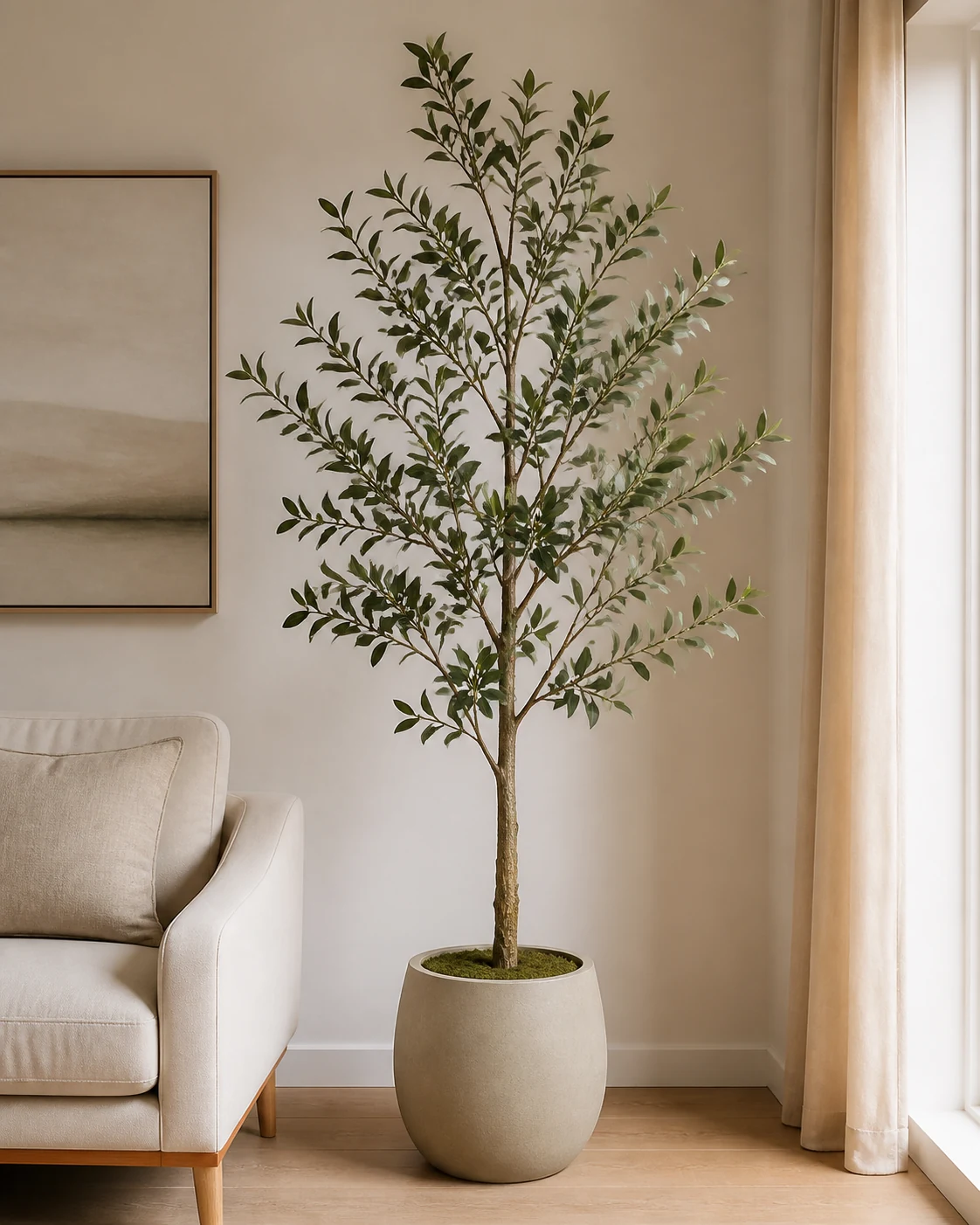
| Faux olive tree | Brighter corner or soft floor anchor | Feels airy, grown-up, and believable when the room needs one lighter tall shape. | Shop |
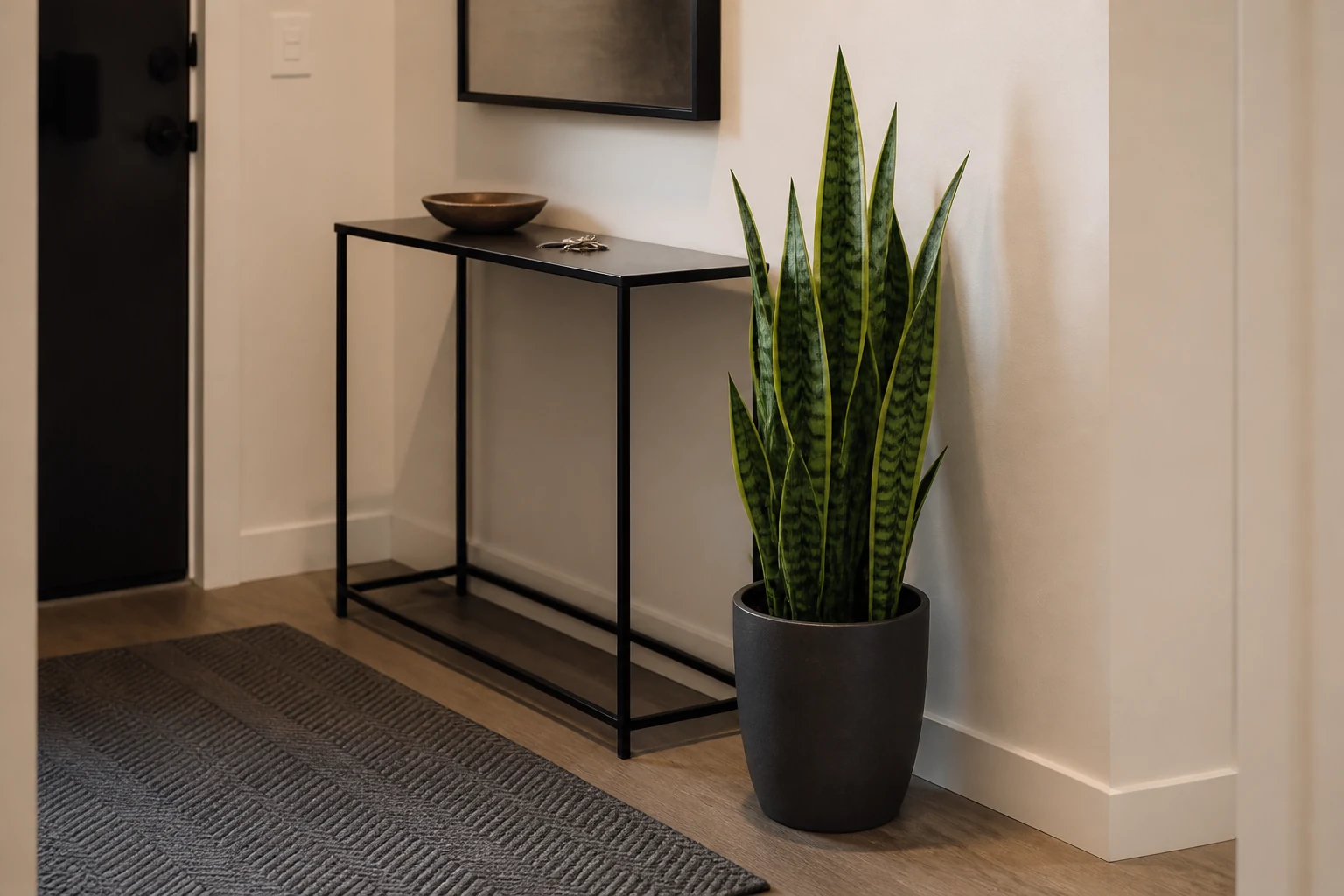
| Faux snake plant | Narrow floor zone or entry cabinet side | Adds lift and definition with a smaller footprint. | Shop |
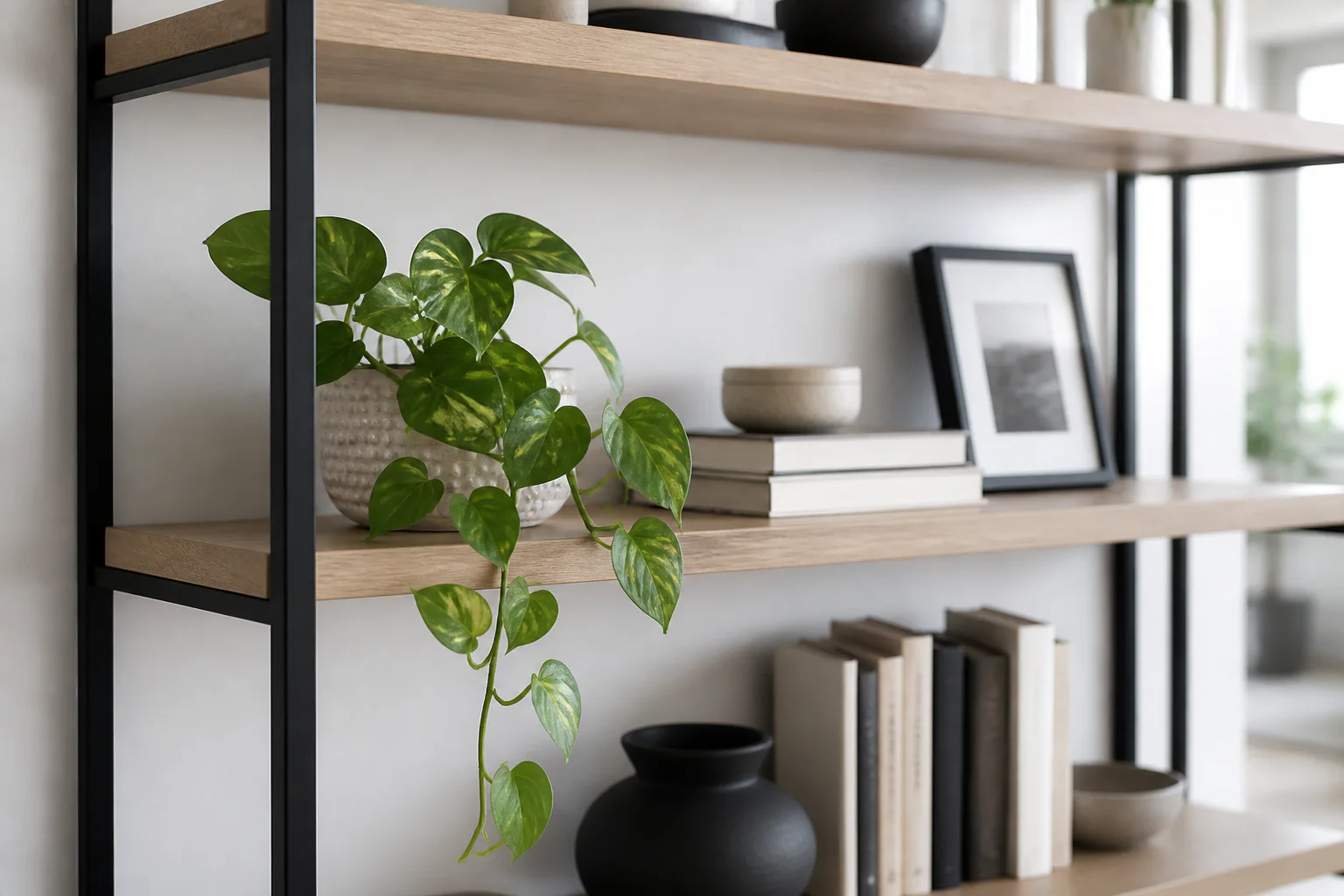
| Faux pothos or trailing vine | Shelf softening | Breaks up hard lines without needing floor space or regular watering. | Shop |
| Faux fern | Bathrooms or softer corners | Adds more relaxed texture where sharper plant shapes feel too rigid. | Shop |
The Best Artificial Plant Directions to Shop First
Treat these as product types to compare, not as claims that one listing will look convincing in every home. Check the listed dimensions, close-up photos, branch construction, planter size, and recent buyer photos before ordering. A taller plant needs enough visual weight to relate to the furniture around it; a shelf plant needs a contained silhouette that will not look like plastic fringe.
Seven faux plant types worth comparing
Choose the shape that solves the room's actual scale or maintenance problem, then judge the individual product on realism.
Airy floor plant
Faux Olive Tree
Best for a living or dining corner that needs one light, tall form. Compare matte leaves, irregular branch spacing, trunk color, and total height.
Compare on AmazonNarrow footprint
Faux Snake Plant
Best for narrow entry and office footprints. Look for varied leaf angles and markings instead of identical rigid blades.
Compare on AmazonShelf softener
Faux Pothos or Trailing Vine
Best for softening one hard shelf edge. Prefer mixed leaf sizes, shorter vines, and visible stem variation over a uniform plastic curtain.
Compare on AmazonFuller corner
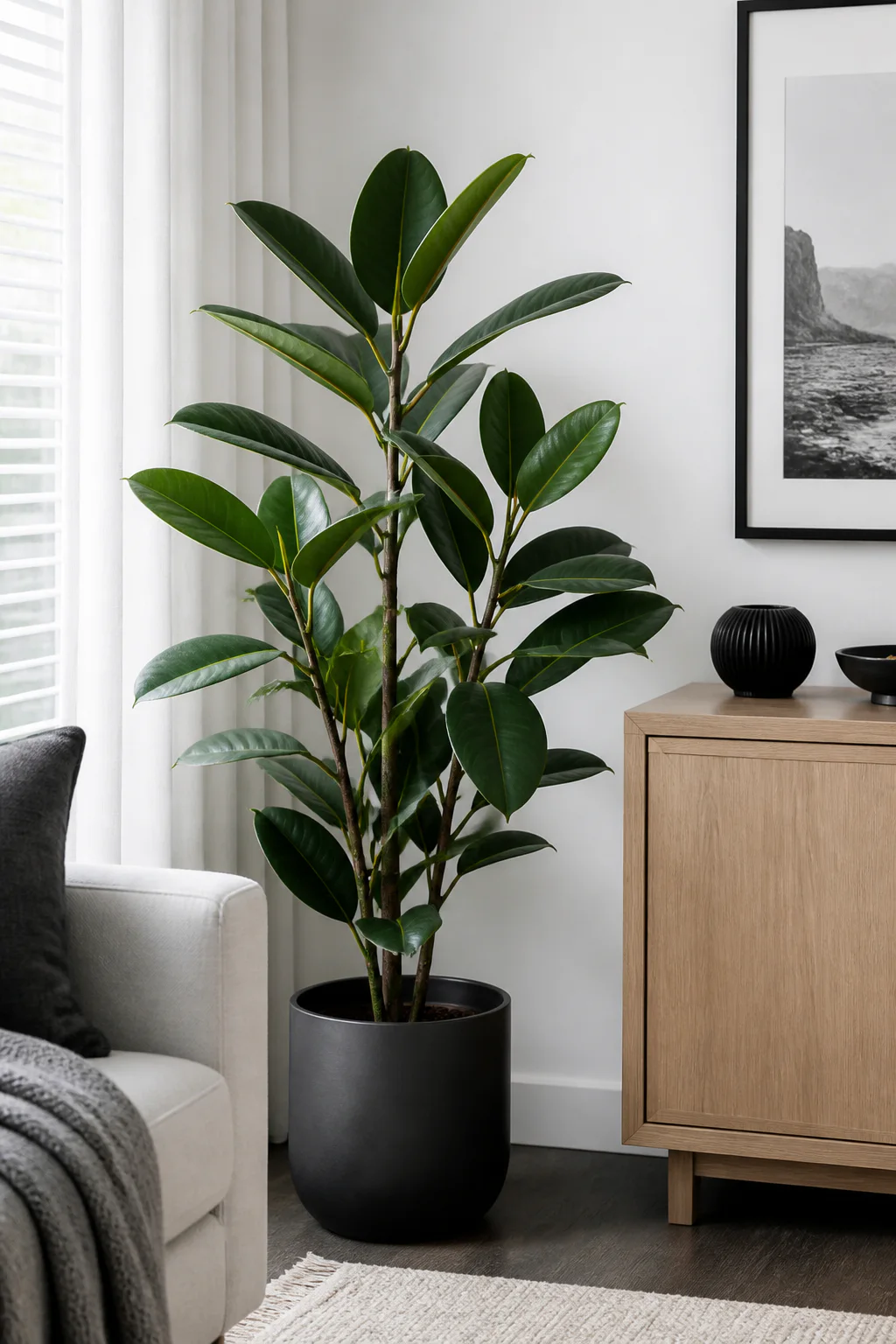
Faux Rubber Plant
Best for a larger room needing a fuller anchor. Avoid overly glossy leaves and use it only where the dark mass will not crowd the room.
Compare on AmazonSoft texture
Faux Fern
Best for softer texture on a shelf or bathroom counter. Check that the fronds vary in direction and do not read fluorescent or flat.
Compare on AmazonTabletop accent
Faux Bamboo
Best as one contained tabletop accent. Choose a restrained pot and construction that does not resemble novelty gift-shop decor.
Compare on AmazonCompact desk
Small Faux Desk Plant
Best when a desk needs one natural-looking cue without losing work space. Matte leaves and a quiet planter look more credible than novelty succulents.
Compare on AmazonWhy Each Faux Plant Makes Sense in a Real Room
The best choice depends less on a symbolic plant name and more on the job the room needs done. A tall tree can finish an empty corner, an upright plant can define a narrow zone, and a trailing plant can soften a hard shelf. Choosing by that practical role makes the result feel intentional instead of superstitious or randomly decorative.
Faux olive tree: the lightest-looking floor plant
A faux olive tree makes sense when a living or dining room needs height without a dense wall of leaves. Its thinner canopy lets light and wall space remain visible, so it is easier to use beside a chair, console, or dining cabinet than a very full tropical tree. The most convincing versions have an irregular trunk, branches that do not form a perfect cone, muted leaf color, and enough height to relate to nearby furniture. Skip short, overfilled versions that look like a green ball on a stick.
Faux snake plant: the best narrow-footprint option
A faux snake plant is useful beside an entry cabinet, desk, or small console because its vertical shape adds definition without spreading into the walking path. That makes it a strong choice for apartments and tighter rooms. Look for several leaf heights, different angles, subdued markings, and a weighted pot. If every blade is identical and perfectly upright, the plant will read as molded plastic from the doorway.
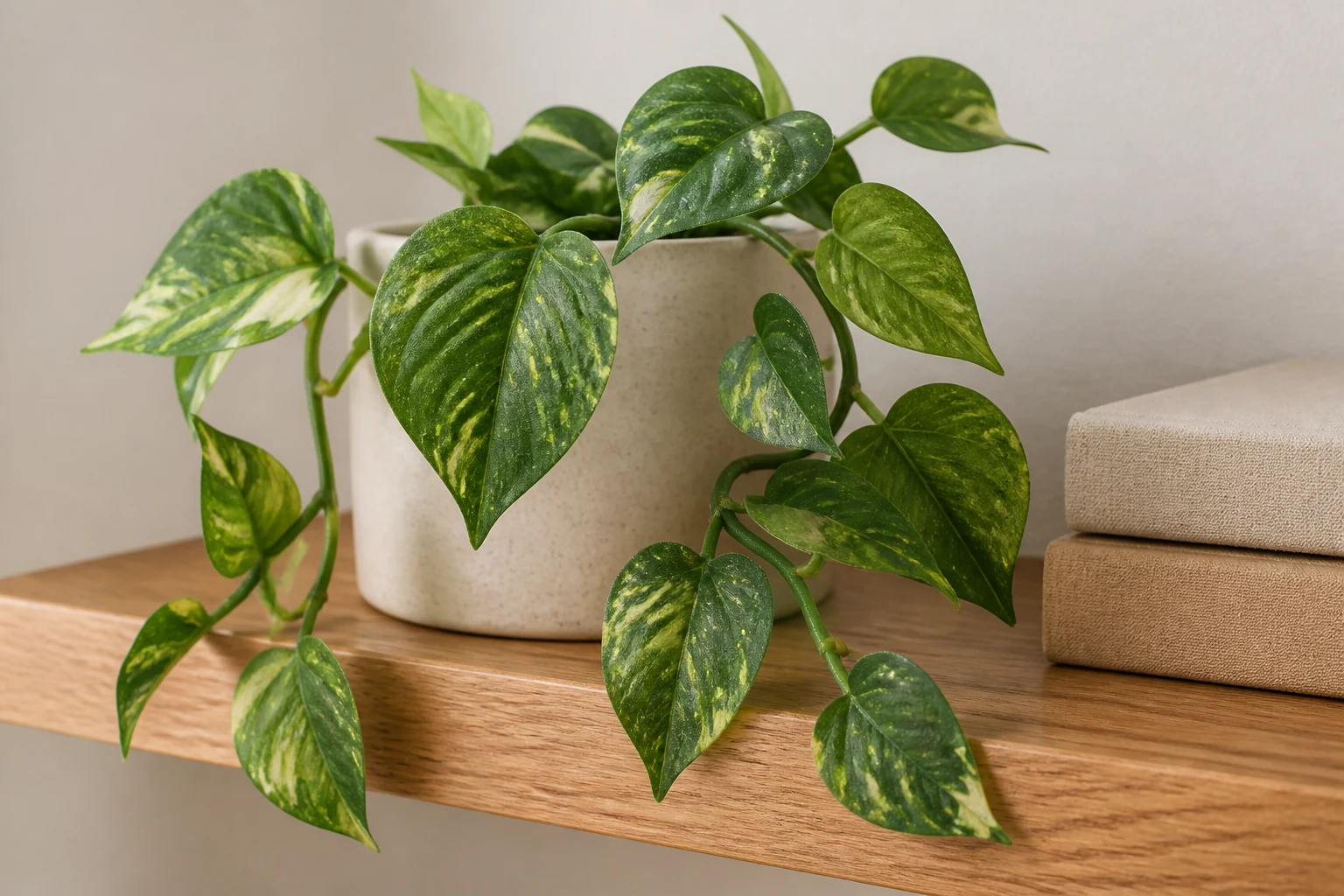
Faux pothos: the easiest shelf softener
Faux pothos works when shelving feels rigid or over-architectural but there is no practical way to water a live trailing plant. Keep the vine contained to one shelf and choose mixed leaf sizes with visible spacing between stems. A shorter trail looks deliberate and leaves books and useful objects accessible; several long identical vines quickly become a plastic curtain that collects dust.
Faux rubber plant: a fuller anchor for a larger room
A faux rubber plant makes sense where an olive tree would feel too thin and several smaller plants would create clutter. Its broader leaves form one grounded visual mass beside a sofa or sideboard. Because real rubber leaves are naturally substantial, this shape can look convincing in faux form, but shine is the giveaway: choose softly textured leaves, varied angles, visible stem structure, and a planter wide enough to support the plant's apparent weight.
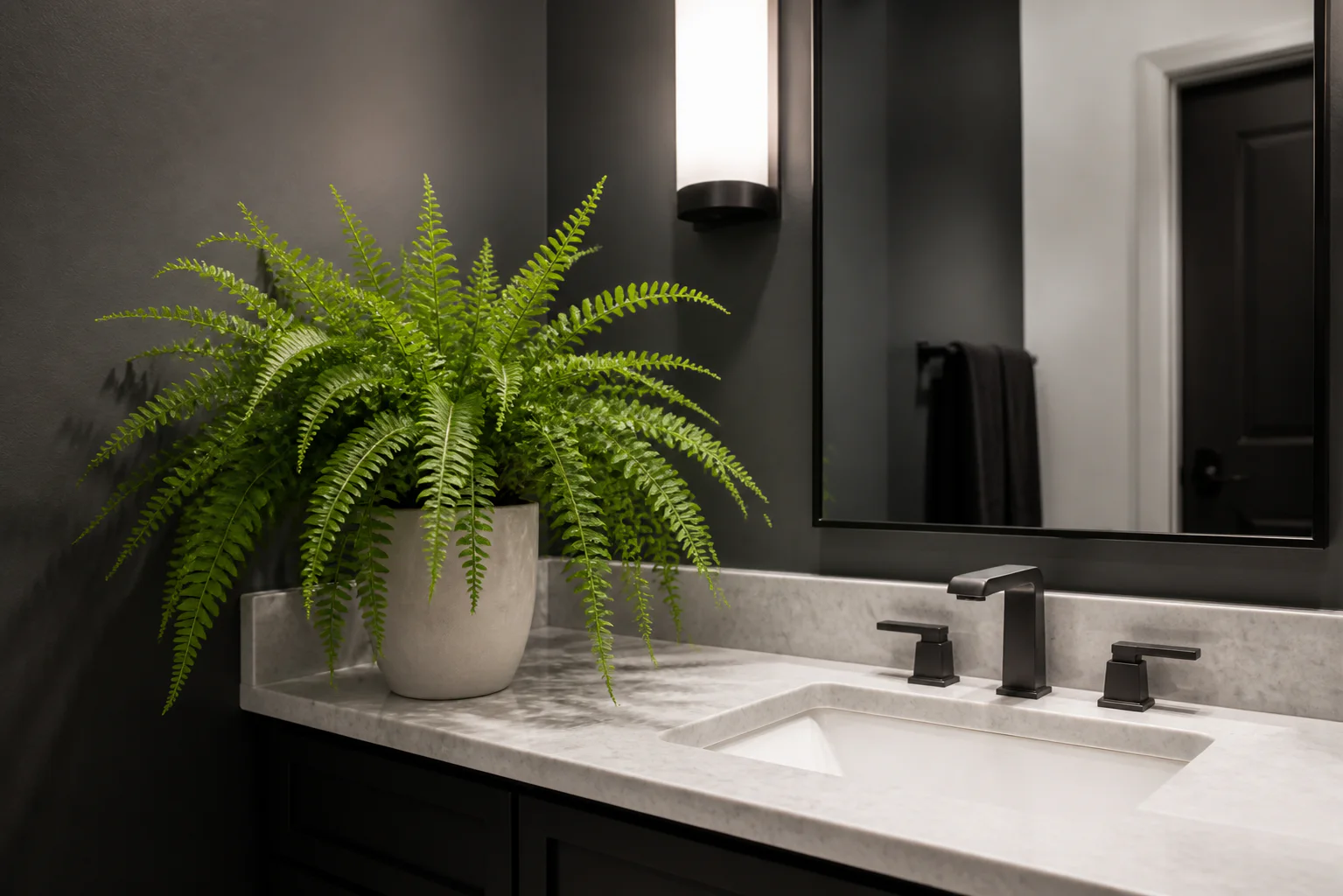
Faux fern: softer texture for a bathroom or hard-edged room
A faux fern is useful in a windowless bathroom or on a high-maintenance counter where a live fern would not receive dependable light or care. Its arching fronds soften tile, mirrors, and straight cabinetry more effectively than another upright plant. Check the silhouette from the side as well as the front: convincing ferns have fronds moving in different directions and several shades of green. Keep it away from direct water spray and clean the fine leaves regularly because dust is more visible on this shape.
Faux bamboo and small desk plants: use them as contained accents
These smaller choices make sense only when the surface genuinely needs one green note. On a desk, the plant should leave room for the keyboard, task light, and everyday work. On a console, faux bamboo should have restrained stems and a plain planter rather than decorative rocks, ribbons, or novelty containers. Their advantage is a controlled footprint; their weakness is that cheap versions can look like gift-shop symbols rather than part of the room.
How to Choose Faux Plants That Look Believable
The best faux plant is not the biggest one. It is the one with the right scale, a matte finish, natural leaf variation, and a planter that looks like it belongs in the room. If the leaves are glossy, flat, neon green, or perfectly repeated, the plant will read as filler instead of calm greenery.
| Check | What to look for | What to avoid |
|---|---|---|
| Leaf finish | Matte or softly textured leaves | Glossy plastic shine |
| Scale | One plant that fits the furniture height | Tiny filler plants scattered everywhere |
| Planter | Ceramic, stone-look, basket, or simple neutral pot | Thin black nursery pot left exposed |
| Care | Dust leaves and refresh the shape regularly | Letting fake greenery look stale or forgotten |
How to Use Faux Plants Without Making the Room Feel Fake
The easiest formula is simple. Use fewer faux plants, choose better-looking ones, and place them where a real plant would make sense visually. Shelves, corners, consoles, sideboards, and some desks all work. Obvious trouble spots are too many fake plants together, overly shiny leaves, bright plastic greens, and surfaces where the faux plant only adds one more random object.
What helps
- +Choose faux plants with believable scale, leaf color, and branch spacing.
- +Use them where a live plant would visually make sense.
- +Keep leaves dust-free and the planter suited to the room.
- +Use fewer better faux plants instead of many small plastic fillers.
What weakens the room
- -Filling every shelf with fake greenery just because the room feels plain.
- -Using obviously glossy, neon-green, or plastic-looking leaves.
- -Letting faux plants gather dust until they make the room feel stale.
- -Treating faux plants as a substitute for fixing clutter, light, or layout.
If you do have the light and patience for live greenery, best office plants for feng shui and feng shui indoor plants are better next reads. If the room mainly needs softer decor instead of more greenery, feng shui positive energy items can often solve the problem more honestly.
The easiest faux plant rule
If a fake plant looks fake from the doorway, skip it. The best faux plant is the one that lets the room feel softer without announcing itself as fake decor.
Frequently Asked Questions
Are artificial plants okay in feng shui?
What are the best artificial plants for feng shui?
What weakens feng shui with fake plants?
Is a fake plant better than a dead plant in feng shui?
The Bottom Line
The best artificial plants for feng shui are the ones that feel believable, fit the room naturally, and stay clean. In many homes, one strong faux plant works better than several weak live plants that never really thrive.
If the faux plant makes the room feel softer and more finished without obvious fakery, it is probably doing its job. If it looks dusty, plastic, or forced, skip it.